Handsome Brook Farm: Setting the Standard

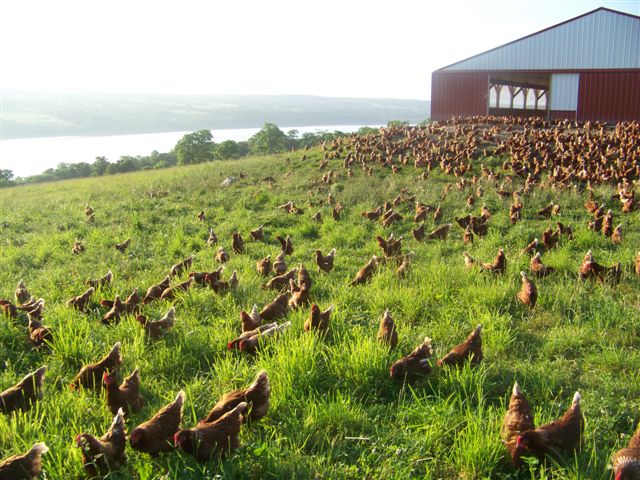
Handsome Brook Farm, one of the Inc. 500 fastest growing companies for 2015, selling eggs from pasture-raised hens. Photo courtesy of Handsome Brook Farms.
Handsome Brook Farm raises chickens the way chickens ought to be raised. They are an Inc. 500 fastest growing company for 2015, selling eggs from pasture-raised hens. Photo courtesy of Handsome Brook Farms.
 You may remember the Happy Go Lucky Chickens post I wrote a few months back, showing the different living environments of small flocks versus mainstream commercial production, and asking which one you would want to eat eggs or chicken from.  It’s an obvious choice for me: I want eggs from chickens that know what grass and sunlight are.

Most people assume, or are told, that it’s just not possible to raise such chickens on a larger commercial production scale.  But, not only is it possible, Handsome Brook Farm is doing just that. Handsome Brook Farm has reinvented tradition and is setting the standard for excellence: this is how chickens should be raised.  These are the eggs our family buys.

Handsome Brook Farm, one of the Inc. 500 fastest growing companies for 2015, selling eggs from pasture-raised hens
Imagine my surprise, opening Inc. and finding my grocery store favorite eggs, Handsome Brook Farm, one of the Inc. 500 fastest growing companies for 2015.
These are the Handsome Brook Farm eggs available at my grocery store.

The availability of pasture-raised eggs at the grocery store is new, at least in my part of the world.  When I think back, about ten years ago, cage free and organic eggs were just barely becoming available in US grocery stores.  While cage free and organic are a step up from caged eggs, the terms cage free and organic do not actually mean much at all in terms of sunlight and grass, and do not even guarantee quality outdoor access (although you would think that they would), and this is when I started seriously considering raising my own chickens. Pasture raised eggs were simply not available in any grocery store near me.  Cage-free chickens are still restricted to about the size of a piece of typing paper, in a windowless barn, and certified organic doesn’t guarantee outdoor access: many organic operations meet an outdoor access requirement with very small cement floored screen porches tacked onto giant barns.  I don’t know how American agriculture has arrived at a point where sunlight and grass are rarities for livestock, but it has.

Within the past year or two, I first came across Handsome Brook Farms and pasture raised eggs in the local Price Chopper. I bet they might be available near you.  And if they aren’t, they likely will be soon.

When you choose food at the grocery store, you are voting with the dollars you spend, you are voting for the food you want to see, and potentially nudging, a bit at a time, a change in direction towards the better.  Consumer demand fuels growth and change in what is available, and that is why organic and then pasture raised eggs even became available for purchase at the local grocery store. The growth rate of organic food sales has been increasing ten percent each year since 2010. This growth is amazing when compared to the three percent growth of total food sales. And, organic foods  sales only make up five percent of the total food sales, so there is room for more growth.  This is due to food dollar voting:  creating markets, evolving standards and products to meet demand.  While our family cannot afford to eat entirely organic or local, or grass-fed, we can make small purchases in eggs and milk and fruit and vegetables and grains that support a better, healthier way of life, and that is why we buy Handsome Brook Farm eggs.

Pasture raised eggs come from hens that know what sunlight and grass are.  They can hunt and peck and frolic as gawkily as they please in the great outdoors.  These chickens have a safe shelter to return to at night, and the pasture to explore by day.  Eggs from chickens that have access to the outdoors, to grass and bugs, have been shown to have more vitamins and lower fat and cholesterol than “conventionally raised” chickens. Take another look, this is how chickens should be raised:

These are Handsome Brook Farm chickens, one of the Inc. 500 fastest growing companies for 2015, selling eggs from pasture-raised hens. Photo courtesy of Handsome Brook Farms.
Photo courtesy Handsome Brook Farm
<span style=
Photo courtesy Handsome Brook Farm
Handsome Brook Farm, one of the Inc. 500 fastest growing companies for 2015, selling eggs from pasture-raised hens. Photo courtesy of Handsome Brook Farms.
Photo courtesy of Handsome Brook Farm.

I was so impressed with these eggs, the network of Handsome Brook farms, and the standards of care on their web site, that I decided to post about them here on Bean & Bantam.   I strongly encourage you to look for their eggs in your grocery store–and to try them.  I request your food dollar vote towards this company, if you please (and thank you).  I have no affiliation with Handsome Brook Farm, and this post is not sponsored, I just very much like the way they raise chickens, and I want to see them grow until they are available in every city, town and store.

I contacted Handsome Brook Farm Co-CEO Betsy Babcock by email to ask her some questions, and here they are, with her answers:

Q: You grew from an initial five hens to providing Handsome Brook Farms eggs across the country.  Can you tell me how you decided to pursue pastured poultry commercially?  Was there a “watershed’ moment or a more gradual process in making the decision to scale up from home production or local production to making these eggs more widely available?

BB:   Our initial growth was spurred by the encouragement of our Bed and Breakfast guests, who raved about how much better our eggs tasted than anything they could find in grocery stores.  After doing some research we realized that it was because grocery store egg hens never go outdoors, and ours did.   We started selling at our local grocery store, then the entire chain (Hannaford).   Our big “break” was when FreshDirect took us to New York City and we saw the incredible positive response and we realized that there was market demand.  We had to make a choice as to whether to grow our own flock, or to scale up by working in partnership with area small farms.  It seemed counter to our philosophy to become “big farm”, so we opted to bring in local farms into our farm group – the best decision we ever made.

Q: Is there a set chicken breed used by Handsome Brook Farm?

BBWe use a Rhode Island Red cross.

Q: What does the future hold for Handsome Brook Farm… where do you see the company in five years?

BBOur goal is to have our Handsome Brook Farm Pasture Raised Eggs in every grocery chain in the United States within the next few years,  and to have our group of farms grow from 40 family farm to 100+ family farms.   We will continue to emphasize animal welfare/pasture raised practices and quality, and our commitment to sustainable principles. Our daughter, Lindsey is now involved in the company – which is incredibly exciting for us.

Q: If you could sit down to breakfast (cooked with pastured poultry eggs of course) with anyone in this world, living or dead, who would it be?

BB:  Our dream breakfast would be Jesus ( who would ask the blessing and give spiritual insight), Richard Branson (for entrepreneurial advice), and our grandparents, who have had such a huge part in shaping our lives.

Photo courtesy Handsome Brook Farm

So there you have it:  Handsome Brook Farm.  Reinventing tradition, setting the standard for excellence in eggs and the way chickens should be raised.  Vote with your food dollars for sustainable American agriculture, chickens and livestock that know what grass and sunlight are.

Crossing to Safety

Bean & Bantam: One day's harvest from the garden, from six or eight plants.

We have this patch of garden, these apple trees, and those woods, to hold onto while we choose.  Sometimes, I think, that is taken for granted.

We have this place we call our own, to garden, to plant fruit trees and raise children and chickens, and we haven’t ventured here from all that far away.  We haven’t sailed across oceans, migrating as my Dutch ancestors did in the seventeenth century to America.   We haven’t traveled here from another home, driven by war. My grandparents did, my grandmother a woman traveling alone with her children, my mother and uncles, traveling through Europe by train during World War II, my grandfather away, in the thick of it.  I heard war stories as a child that would make your hair stand on end, but I haven’t gone through it myself.  I can only imagine the journey, and remember the stories about the attempt to cross the perilous and enter into safety, to shelter from bomb blasts under piles of suitcases tumbled into and out of a targeted train, picking a way through bomb craters, swims through icy rivers and long roads.  The risk, the danger, the war stories that, as a child I grew impatient hearing over and over from one particular grandparent, trying to settle in  for the long story, not being able to quite resign oneself to hearing it again.  Many of those, I’ve mainly forgotten, but I do remember some, mainly the ones from those that rarely spoke of it.  I’m lucky to be here.

With the recent news coverage of refugees in my mind, I’ve felt mixed about posting pictures of baskets overflowing with tomatoes and apples, about posting pictures of the extraordinary abundance this year.  Those that do not have a place to call their own, those even who are fleeing from war, their stories recall memories of stories long ago.  I feel just one or two steps removed, filled with empathy, unable to help in any real way, thankful for what I have, and a sense of horror for what others have lost, or risk losing, in their attempt to cross to safety.  A small boy in a red tee shirt and blue shorts, the same age as my son, indelibly etched in my memory from the news this week.   And, Matthew Price of the BBC tweeting about a walk from Budapest, for eight hours or more, with a Syrian mother, pushing her two year old in a stroller, her four year old beside her, holding her hand (and Mr. Price’s kindness in lifting him up onto his shoulders and walking the rest of the way with them, in the dark by the side of the road with other refugees).

As the seasons move forward, as the months and years go by, as we make our way through life, this land is ours for a bit, and to have that, to know where we will sleep and what we will next eat, we are fortunate, more than we may realize.

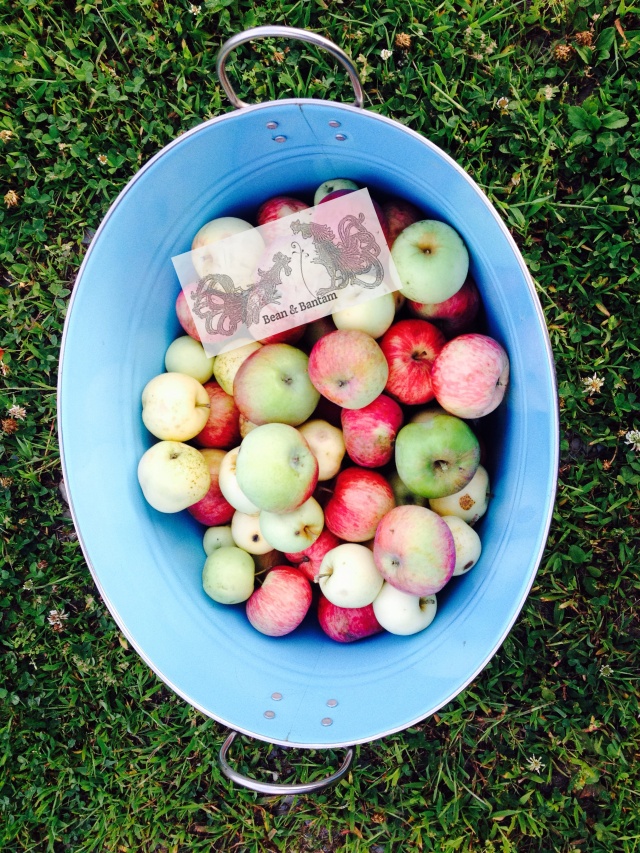
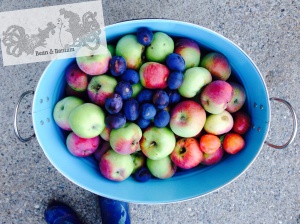
Bean & Bantam: Apples and plums from our own trees

In the garden, September is a leg of the garden journey, the month we travel into fall’s rush of leaves and eventual stark branches, and then on to winter and long nights lit by candles. September in the garden is a month of departures and slow good byes.  The lush garden season comes to an end this month; we do not extend the season with sheets or cold frames, or hoop houses (yet).  It’s been hot, and dry for the past two weeks.  The cucumber leaves crisped, then the pumpkin leaves.  So dry, that the sunflower leaves wilted, as did the morning glory vines I planted to climb up them.  I hauled the hose over, and watered what I wanted to keep: the sunflowers, the morning glories, the rainbow Swiss chard and the kale.  The beans are too far gone.  The potatoes need to be dug, the plants long ago withered.  I pulled ripe jalapenos into a basket, and a final harvest of tomatoes.  I went through the pumpkins, and cut them from the vine, leaving a generous stem end to cure and dry.  The tomato plants were blighted, the leaves entirely brown, so once the tomatoes had been picked, the plants were uprooted and piled into the wheelbarrow, the wire tomato cages and stakes pulled and stacked.  Next year, we need tomato supports made of  2×4’s, if we grow this variety again (Big Beef).  I am not joking, I need serious tomato supports.  A lone cherry tomato is left, ‘Supersweet 100’ an indeterminate sprawling plant, the leaves still lush.  The corn plants cut, or pulled.  Last year, we left the corn to stand through October, a spooky seasonal end to the garden, but this year I want them gone, to better reveal the row of sunflowers with morning glories climbing.

I was driving home the other night, and a car pulled to a stop in the other lane, full of teenagers, their heads craned to the lane far in front of me.  I slowed, and stopped, unsure as to what the problem might be.  A back door opened, and a teenager in a red shirt, basketball-tall and gangly, stepped out and looked at the road, looked uncertainly at me.  I made a “go ahead, be my guest” gesture with my hand, waving him into my lane, in front of my  car, where he picked up a turtle that I could barely even see, and brought it all the way across the road.  I smiled and drove on once the road was clear.  People can be so kind when they choose to.

If only it were so easy the world over, and among human beings, as complex as they are.   If only we could make consideration, or mercy, mandatory. We must all reach up, reach down, and reach across to others. We are lucky to be here.  We are all, in our own way, crossing to safety, some on much more perilous journeys.

Wishing safe travels for all, and that all may cross to safety.  Fall abundance in VermontBean & Bantam: dehydrating apples

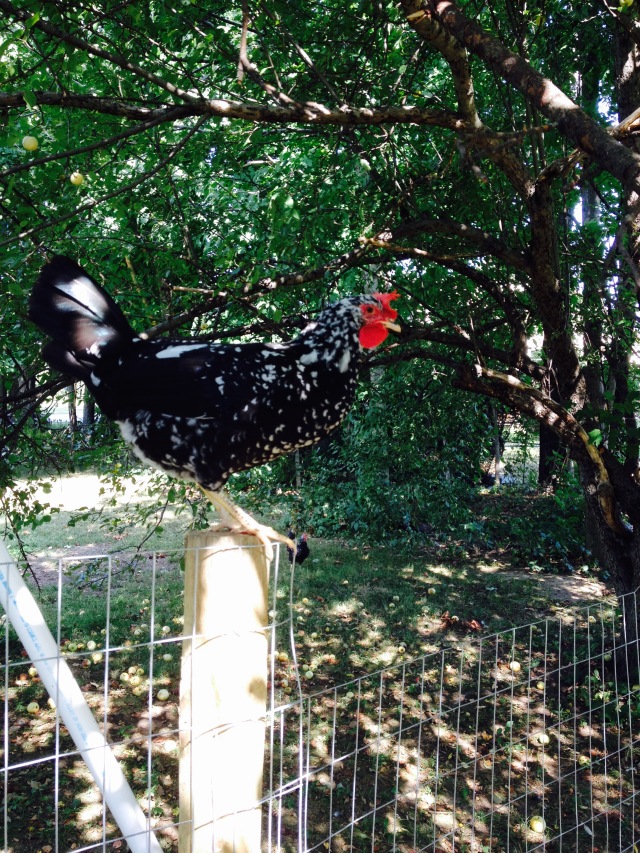
Bean & Bantam: Sun dappled shade, dappled chicken
Sun dappled shade, dappled chicken