Mysterious “Skinner’s Cave” in Manchester, Vermont

As a follow up to my earlier post on Mount Equinox, I have found a mysterious reference to an “ice cave” (containing snow in mid-July) on Mount Equinox in Manchester, Vermont, in an old book, pictured below.  I have no idea where this might be, but it looks like it could be tracked down from the description in this 115 year old book, Glacieres; or Freezing Caves by Edwin Swift Balch, published in 1900 by Allen Lane & Scott of Philadelphia.

Take a look (and tell me in the comments if you have seen it!!!):
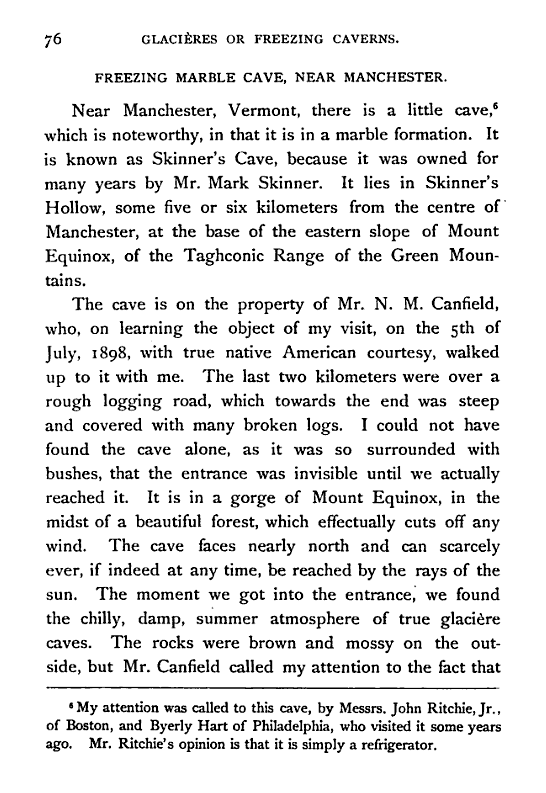
Skinner's Cave on Mount Equinox in Manchester, Vermont From “Glacieres; or Freezing Caverns” author Edwin Swift Balch published by Allen Lane & Scott in 1900
Author Edwin Swift Balch published by Allen Lane & Scott in 1900.
Skinner's Cave on Mount Equinox in Manchester, Vermont From “Glacieres; or Freezing Caverns” author Edwin Swift Balch published by Allen Lane & Scott in 1900.
Author Edwin Swift Balch published by Allen Lane & Scott in 1900.

I ran across another, even older, reference “Skinner Hollow is a deep amphitheatrical gulf on the south side of Equinox Mountain which has a cave so profound that snow remains there all year.” From New England: A Handbook for Travelers published in 1879 by The Riverside Press, Cambridge.

Are you familiar with Mount Equinox and have you hiked it?  Ever seen Skinner’s Cave?  Please do tell in the comments below.  Navigation tips to the cave appreciated.  For more information on Mount Equinox please see my earlier post.
Robin Tales

watercolor of a robin signed "Wooster"
watercolor of a robin signed “Wooster”

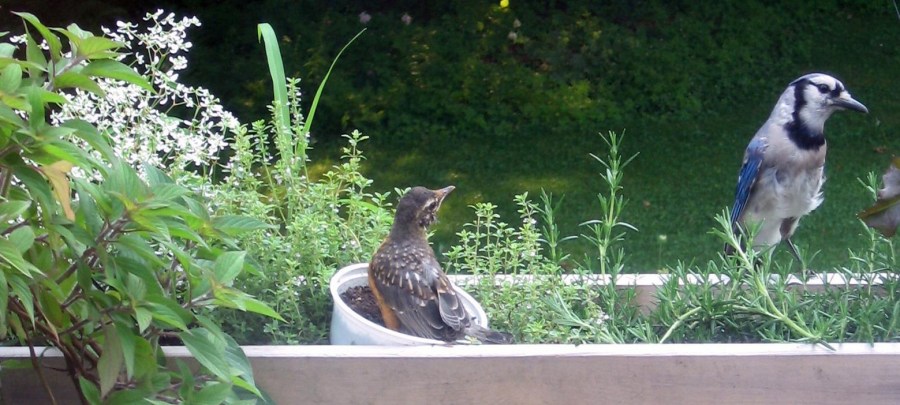
Yesterday, I had written that I was hoping for a hint of spring “crossing my fingers for a little bit of spring magic. Some greenery, a slant of light, maybe a bit of bird fluff” and today as I walked back to the office from my car, carrying some forced hyacinths tucked in a bag, a  robin chirruped at me from the top of a three-foot snow bank.   It’s a bit early for robins in Vermont (although some do overwinter here).  I saw a flutter of feathers, the tilt of a head, and robin eyes focused in my direction, not even three feet in front of me, on top of a snow bank between street and sidewalk.  I slowed my pace, the robin looking straight at me (well, as straight as it could with a tilted considering head). And then, a little hop or two on bird feet and it “chirruped” at me. I stopped completely, a bit uncertain at being so closely considered: avian scrutiny and at close proximity. And just like that, away and gone, while I followed with my eyes, across a roof and out of sight.  Continue reading “Robin Tales”