
Transitions, dusk and dawn, the “in betweens” that fall between day and night and of seasons, fall and spring, these times are on the borders and edges. The edges of days and nights, the edges of seasons, the edge of time as it changes from “then” to “here” to “was”, and the edges of documents and ideas: the edges and borders of life are where anything is possible (even if just an increment at a time), and where change can occur and where (I think) the most interesting parts of life happen.
The edges and borders of childhood and subsequent years, the unknowns of what could have been from then, to here, and onward. Sitting before a wide open window as a summer evening begins to darken, watching blinking fireflies, I can remember what it felt like to be a child on summer nights long ago. I remember time seeming to stretch out infinitely ahead.
There is a border too, between memory and habit, the past and the now. Each time I save a new Word document, a date comes up, the same date every time, always the same reminder from the past, like a ghost in the machine, a several times over daily message “remember this always” and I click and highlight and save over that date with a new file name every time, as I type into that edge on the border of existence, saving, remembering.
The other night we had a visitor make an appearance after a long absence: an enormous porcupine walked out of the woods and across the lawn. This same porcupine has made the trip before, I have seen it a handful of times, and I know it is the same animal, remarkable in that it’s larger than any porcupine I have ever seen, the size of a 40 pound dog, always walking with a limp and always set in its course from the woods to the apple trees, then across the road through corn and to the river. Since the last trip made, the chicken coop fencing was new, set across the porcupine’s usual path, and the porcupine walked right into the fence. It must have been walking by memory rather than sight. It struggled in trying to get under (the fence bending, the porcupine determined), and then the porcupine backed away and reset to walking in a new course, a narrow slice trimmed off routine habit, a new path.
Earlier tonight, another visitor, this time a large gray fox. I caught movement out of the corner of my eye through the back window, and saw the fox not twenty feet from some free ranging chickens. Gray foxes are taller than red fox, with longer legs. He (she?) was stalking, lurking behind a mulch pile, eying my chickens. I stepped out onto the deck, said something to the effect of “hey! you! get away from my chickens!” and it left, away into the woods. We stayed outside to keep an eye out until every chicken was safely roosting and locked up tight. Battle won, war no doubt to follow. These chickens are mine, I am drawing a line that fox had better not cross.

But back to the border between memory and habit, the past and now: “so what” you may ask. What does it matter? I asked myself this, and I poked around a bit, and I came across a fascinating bit of quantum physics theory about how we, the world, the universe, all is held together by “quantum entanglement on the boundary.”
“In 2010, Van Raamsdonk studied what that means when quantum particles on the boundary are ‘entangled’ — meaning that measurements made on one inevitably affect the other.* He discovered that if every particle entanglement between two separate regions of the boundary is steadily reduced to zero, so that the quantum links between the two disappear, the three-dimensional space responds by gradually dividing itself like a splitting cell, until the last, thin connection between the two halves snaps. Repeating that process will subdivide the three-dimensional space again and again, while the two-dimensional boundary stays connected. So, in effect, Van Raamsdonk concluded, the three-dimensional universe is being held together by quantum entanglement on the boundary — which means that in some sense, quantum entanglement and space-time are the same thing.”
Quote from Nature.com August 28, 2013, Theoretical Physics: the origins of space and time by Zeeya Merali
* SOURCE Raamsdonk, M. V. Gen. Rel. Grav. 42, 2323–2329 (2010)

My (non-scientific) interpretation of this is that some of the answers to who we are and why we are here might be found in the entanglements on the boundaries, the edges in flux, the connections between discrete parts, and the “in betweens.” Threads in the fabric of existence, the edge of time as it changes from “then” to “here” to “was”, and the edges of documents and ideas, the edges of objects, the edges of atoms. Interesting, no?
For interesting reading on quantum physics,
please see physicist Christopher Fuchs and this article in Quanta magazine.
For interesting science reading, definitely visit Quanta Magazine
For more on Mark Van Raamsdonk, I recommend this article on FQXi Community.
If you liked this post, you’d probably also like A Simple Rearrangement of Atoms.
You may wish to subscribe by email, so as not to miss any of these hodge-podge posts about
odd thoughts, chickens and seemingly random things…
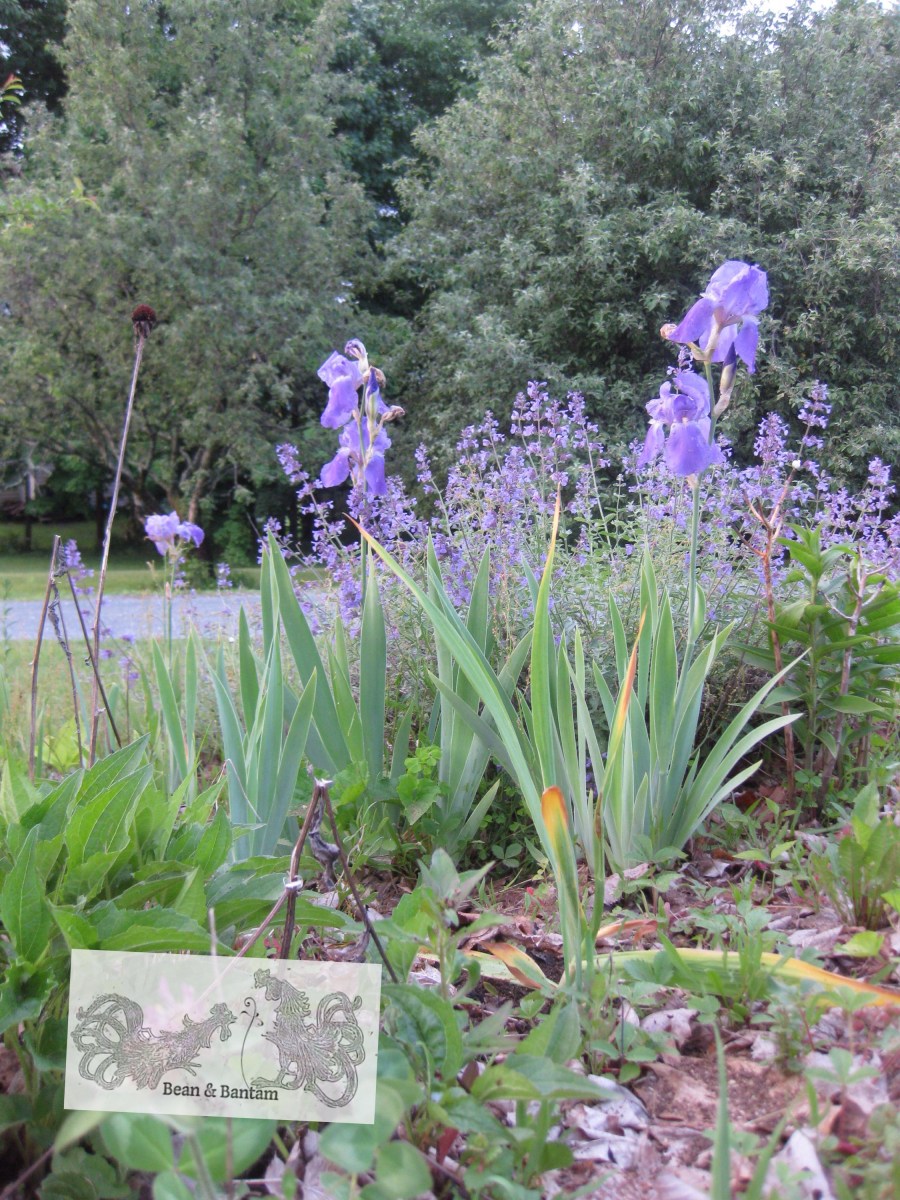
 June is the month for fireflies here, with their glow and glimmer over and through meadows filled with grazing cows at dusk. June is a month of warmth, of summer blooms, heavily scented peonies and roses, and sudden storms and sunshine.

 The chickens range, catching worms, feathers in the breeze, the coop windows open wide.Yesterday, I saw one look at some leaves just overhead on a low-hanging branch, and then jump up with an open beak to get a bite. It reminded me of the way teenage boys will leap up to touch the top of a door frame on the way through, because it’s there, because they can. Just weeks ago, in March and April, these chickens were the size of golf balls and now they are almost full sized, enjoying the outdoors as they range from the wide open sun to the dappled shade underneath apple trees, and young plum and birch trees.

 If you want to try your hand at giant pumpkins and some over-sized Jack o’ Lanterns, it’s not too late this year, they can be planted as late as July and still be ready for October. So go ahead, plan ahead now for some October magic.
 BEAN & BANTAM